As-salamu alaykum. We're happy to feature inspiring stories of Muslim creatives from around the world. From filmmaking to poetry to news reporting, each of these creatives are putting their unique spin to storytelling and showing the world what it means to own your narrative.
Let's dive in!
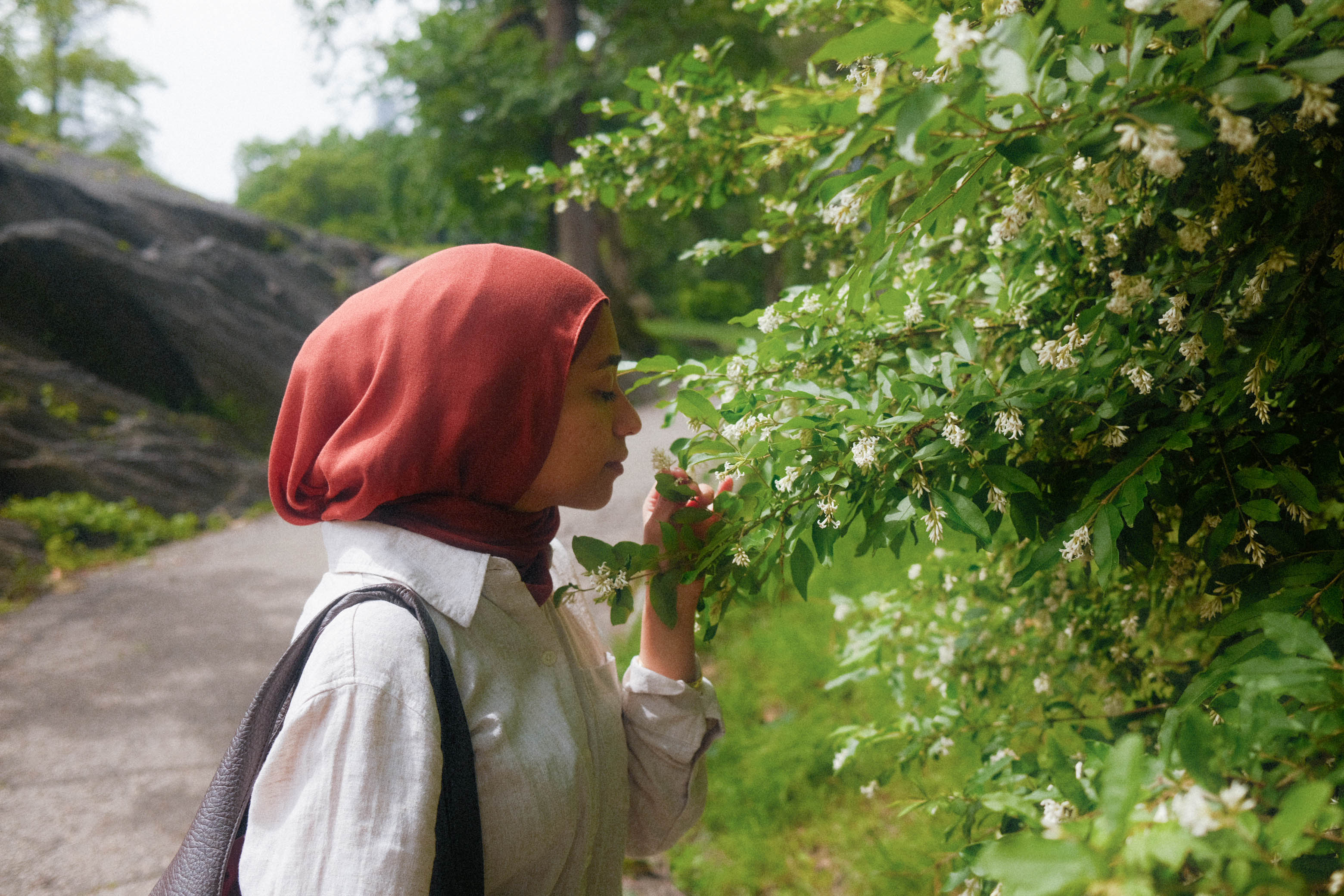
Creative of the Week: Amena Bakali
Meet Tamanna Ali, a perfumer who has dedicated herself to creating scents that are inclusive of every nose, even the delicate ones. She's focused on developing scents that are non-synthetic, sourced ethically, have natural ingredients, and long-lasting. Her efforts are towards preserving olfactory heritage, a unique relationship we each have with scents, culture, environment and community that fundamentally shapes our imagination. It frames how we think and create, letting us travel across time and culture to understand histories and places we’ve never lived.
What’s the story behind your creative journey? Tell us how you got started, and what moment made you realize this was your calling?
Qasr means a large fortified mansion and residence belonging to the people of Jannah. Believers who are longing for paradise and the afterlife (akhira) are longing for the unseen and scent is unseen. It is said that the sweet fragrance of Jannah can reach you from hundreds of miles away from your grave.
I have a sensitivity to synthetic perfumes they leave me nauseated, give me headaches and can even trigger motion sickness. For a long time, I felt sad that I might never fully experience the beauty of scent. After some research, I discovered the rich tradition of perfumery in the Islamic Golden Age and learned that wearing fragrances is a sunnah of the Prophet Muhammad (peace be upon him). Our beloved Rasulullah loved wearing deer musk and roses, and encouraged us to wear perfume to the prayer space and for Eid celebrations. This piqued my curiosity and led me to explore oil-based fragrances called attar (or itr), which felt deeply therapeutic for my mind and spirit. That was the moment I decided to start my own artisanal perfume business.
How does your cultural or faith background influence your work? We’d love to hear about the unique perspective you bring to your art.
As a Bangladeshi-American, I grew up surrounded by a rich tapestry of cuisine, spices and tea. That sensory world has always felt like home. This isn't just personal nostalgia. My heritage is woven into the ancient Spice Route, so fragrance and flavour have been part of our story for centuries.
In fact, the Sylhet region of Bangladesh produces some of the rarest and most prized agarwood in the world which is called the Assam oud, and knowing that connects me to a lineage of craftsmanship I now carry forward in my own work.
Growing up in Bangladesh, I have vivid memories of visiting mazars and shrines where I’d see hanging bodnas (a traditional spouted vessel) filled with scented perfume, gently fragrancing the air. Later as I travelled, I encountered the burning of bakhoor and incenses in mosques. A practice that felt instantly grounding and so spiritually elevating. It was a reminder that scent has always been a bridge between the physical and the unseen world.
All of this comes together for me in Madinah, my favourite city in the world. From every corner, the streets carry beautiful waves of scent that guide you toward the Prophet’s Mosque. The perfume stores there stay open 24 hours a day too, which I found it to be very fascinating.
What’s a project you’re especially proud of, and why? Walk us through the creative process and why it holds a special place in your heart.
The project closest to my heart is the one I’m building right now. My vision is to collaborate with Muslim-American perfumers, artists and chemists to create perfume accords rooted in our shared olfactory heritage. Muslim Americans are a beautifully diverse community made up of different ethnicities, races and cultures. Each of us experience our scent heritage in a uniquely personal way. The creative process so far has been deeply collaborative. For the first edition of the Qasr Scent series - I’m gathering stories, memories and aromatic references from contributors, then translating those into scent profiles that feel both intimate and collective.
If you could collaborate with any artist (living or historical) from the Muslim or ethnic diaspora, who would it be and why?
If I could collaborate with any artist it would be Ensar Oud. He’s a master perfumer and an artist whom I look up to immensely in this field. Our stories feel intertwined in so many ways. We both started our journeys in Queens, New York. Although he’s been at this since 2004 and I’m just beginning to find my footing. He has carved out a path that very few in this profession have ever dared to take and simply knowing it exists makes my own dream feel possible. InshaAllah, I hope that Allah (SWT) brings our paths together, and that one day I am blessed enough to call him my teacher.
What’s one misconception about your art form or your community that you’d like to challenge? What do you wish more people understood?
One major misconception is that perfume-making is purely an intuitive art of making things smell good.
In truth, the meaning of this work runs far deeper than pleasure. The nose is a sacred instrument and a good scent has the power to heal the mind, body and spirit. What you’re really paying for when you buy artisanal perfume isn’t just a bottle - it’s years of craftsmanship, support for local farming, ethical sourcing of raw materials, the endangering practice of wild harvesting and the rigorous training that happens in perfumery school.
Another misunderstanding I often encounter is that agarwood which is also known as the sacred tree is not pleasing for the Western nose, simply because it’s unfamiliar and therefore its beauty can’t be fully appreciated. I see it differently. Yes, introducing a new olfactory layer is challenging but it’s also a profound opportunity. That’s why storytelling will play a huge role in my company’s journey to translate the soul of these raw materials for audiences who may never have encountered them before and to invite them into an experience that goes far beyond a passing fragrance.
How can our community support your work and stay connected with you?
I think people can support my company by bringing in their creative talents and expertise whether it be through mystical poetry, Sufism, historical arts and knowledge on the Islamic Golden Age, academic research on contemporary Islam in the West, scent science, photography or documentary filmmaking.
I want to see this company grow for the pleasure of Allah swt. To do that, I have to first address the issue we are facing today - the division of the Muslim population. It is my hope and dream that one day we can all organize and support each other as a community.
Follow me on instagram and keep an eye on the first collection dropping soon!
@ tmna.nyc @ qasr.scent
And I would love to collaborate with creative artists in filming and production.
💌 Stay Connected

Enjoyed this feature? Send others our way. Invite them to subscribe: https://behindthekufi.mykajabi.com/newsletters/behind-the-kufi/subscribe
Who should we feature next? If you have a suggestion, send us an email at [email protected]
Follow us on Instagram, TikTok, & LinkedIn and visit our website, www.kufiproductions.com, for more content throughout the month.
Until next time,
The Kufi Productions Team
Responses